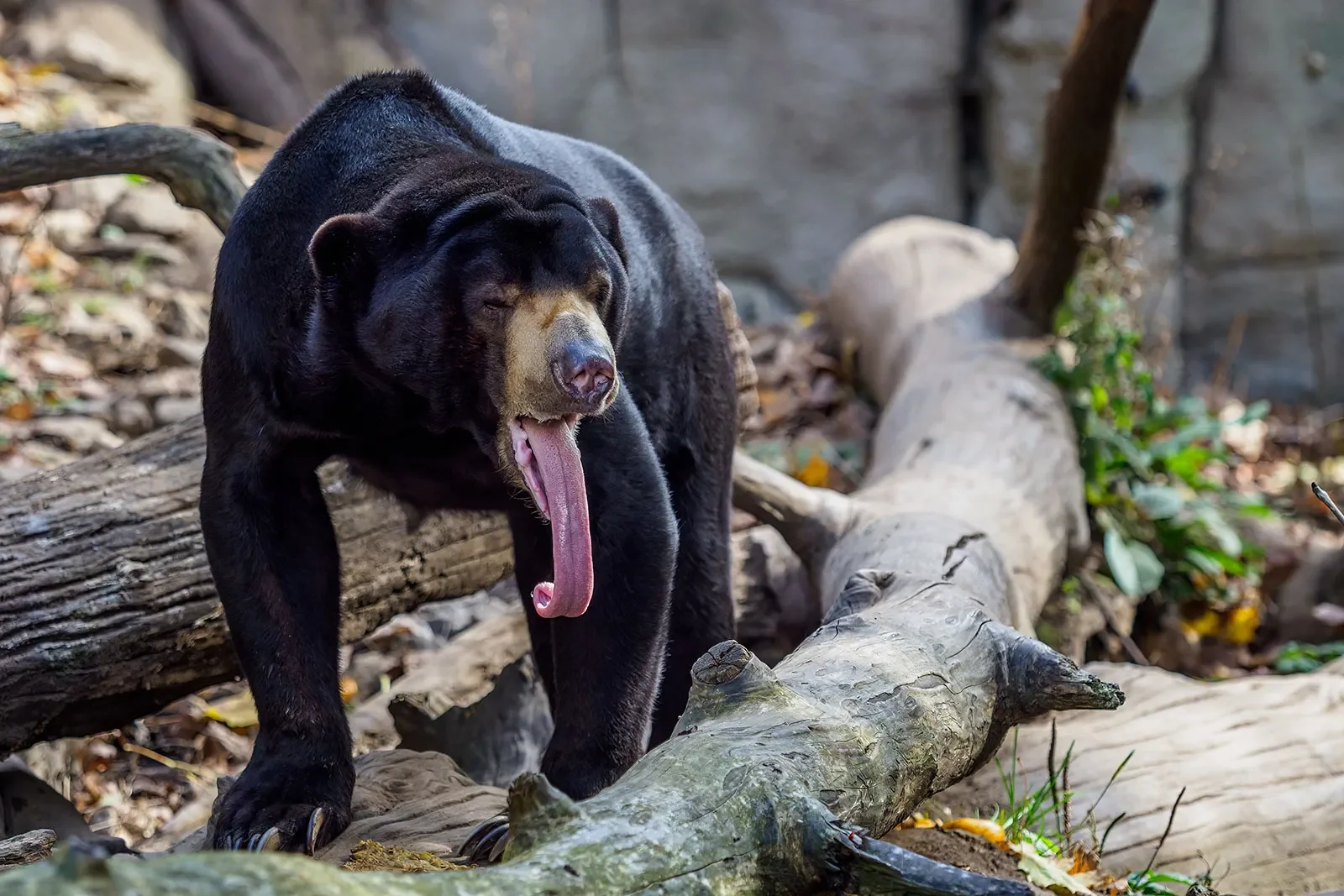
Sun Bear (2) vs. Aardvark (7):
Sun bears (Helarctos malayanus) are smaller than the average bear at 25-65 kg. They have claws adapted for digging and climbing, with bowed legs and inward facing paws that help them arboreally. These traits help sun bear obtain one of their favorite foods: figs! #GrubDigger AND #FigFancier. Aardvarks (Orycteropus afer) are fossorial, meaning they are well-adapted for digging, which is one reason they are the only extant member of their Order. Other members of this group were less fit for the digging life, and this may be part of the reason these populations went extinct.
Back in Ulu Segama Forest Reserve, Malaysia, Sun Bear is approaching one side of a termite mound! While he eats a lot of fruit to build up fat reserves for lean times, his long, narrow tongue and mobile snout allow him to eat a lot of termites. Sun Bear's large canine teeth -with flaring zygomatics- make a big bite force for an omnivore his size. This strong bite is for tearing into trees and termite mounds. Combatant Sun Bear's canines are intact, but males often have broken canines as the result of intraspecific fighting. Sun Bear uses his claws and teeth to break the termite mound into a few pieces and quickly eats the termites from the exposed mound. He then sits straight up, grabs a piece of mound with his front paws, and licks termites from the surface of the mounds.
Meanwhile, Aardvark is still in Nama-Karoo. Busy with his cute snout to the ground inspecting for ants and other inverts, he zags his way into MMM portal to Ulu Segama and to the OTHER SIDE OF THE TERMITE MOUND FROM SUNBEAR! Aardvark's nose is flat on the ground, sniffing loudly. The "fleshy tentacles" (Kingdon 1971) of his nose are adapted to chemical stimuli and for sensing termites' reaction to his loud sniff. Aardvarks have the highest number of endoturbinals recorded in mammals. Unaware of the nearby Sun Bear, or even what a bear is, Aardvark scratch digs into the soil by the mound, flexing his limbs and using his long forearm to loosen soil and pushing it behind him.
Sun Bear hears Aardvark's digging and leans around the termite mound to see Aardvarks rump sticking up from the hole into the termite mound. While "inoffensive and timid if not bothered"... SUNBEAR IS BOTHERED!!! (Fitzgerald and Krausman 2002).
Unaware of the approaching Sun Bear, Aardvark's eyes are closed to avoid getting dirt in them (his long eyelashes stop the debris from getting close). As Aardvark digs, his nose hairs interlock to prevent soil getting in. Aardvarks tongue flicks into the nest, catching invertebrates to its sticky surface, gobbling them up like a vacuum. In a 3-point stance, Sunbear swipes his powerful claw-tipped paw across at Aardvark's rump, slashing into the Aardvarks thick skin! Aardvark jump-buck-turns and finds himself trapped between the aggressive Sun Bear and the termite mound!
Aardvark stands full height on his hind legs and tail, nearly as heavy as Sun Bear. Aardvark raises his thick-nailed front feet strong from digging. When faced with danger, Aardvark's "can get very tempestuous and aggressive" (Knöthig 2005). Sun Bear also stands on his back legs, readying for battle, shifting weight between his two legs. Aardvark shifts, steps sideways along the termite mound, and away from Sun Bear. Sun Bear shifts, steps sideways the opposite direction, away from the Aardvark. Aardvark takes one more side shifting step, dropping down on all four feet backing away from the Sun Bear... backing over softer dirt away from the termite mound watching the Sun Bear. Aardvark uses his hindlegs to shovel and flick dirt backward while digging. The webbing on his hind feet makes this easier, flicking sandy soil backwards at a very fast pace. In 10 minutes, Aardvark has a pretty deep escape burrow, getting down to the underground in the soft soil... DIGGING AWAY FROM THE FIELD OF BATTLE! Sun Bear INTIMIDATES Aardvark!
Narrated by Marc Kissel and Katie Hinde.